AI-based Statutory Planning Automation
FEDASEN’s AI-based Statutory Planning Automation solution helps Australian councils deliver faster, fairer, and more transparent planning outcomes, with human oversight built in at every step.
Our platform supports statutory planning processes end-to-end, providing grounded decision support, intelligent workflows, and secure integration with council systems. Our generative AI platform, FeCo (FEDASEN Copilot), delivers natural language interaction, retrieval-augmented generation, and role-based access to complex planning data, tailored to the needs of local government.
What the solution delivers
Human-centred decision support: FeCo augments planners; it does not replace them. The system produces evidence-linked analyses, alternatives, and confidence cues that authorised officers can accept, edit, or reject, with mandatory human sign-off for critical outputs. Every interaction is auditable, enabling traceability from AI suggestion to final decision.
Domain-adapted AI capabilities: FeCo combines domain-specific large language models, clause-level natural language processing, geospatial AI, and multi-agent orchestration to support planning tasks such as pre-application guidance, application classification, referral management, templated report drafting, objection synthesis, and permit documentation.
Seamless integration: The platform connects to council systems through APIs, including TechnologyOne, Pathway, SAP, and ArcGIS, ensuring planning information flows securely across existing records, GIS, and enterprise platforms.
Proven transferability: FeCo has been implemented in real-world council operations, demonstrating natural-language access to complex datasets, scenario-based analysis, and structured reporting, all readily adaptable to statutory planning workflows.
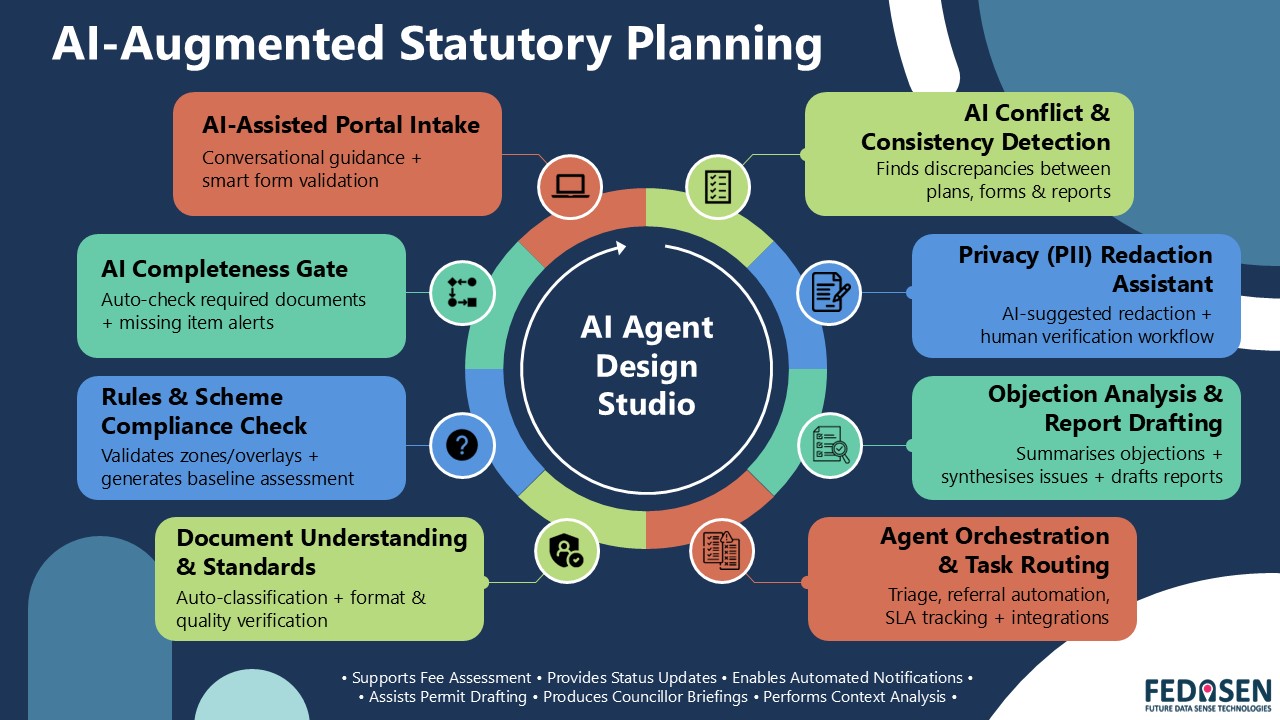
What the solution delivers
Configurable knowledge and controls: Councils can load planning schemes, policies, templates, and historical decisions into a trainable knowledge base. Confidentiality tagging and role-based access safeguard sensitive information, while human-in-the-loop configurations and dual control gates are applied to high-risk workflows.
Multi-agent orchestration: Specialised agents coordinate tasks such as geospatial validation, document bundling, and referral scheduling. An orchestration core supervises execution, maintains shared memory, and produces explainable AI logs for traceability.
Grounded outputs with citations: FeCo uses retrieval augmented generation to anchor responses in council sources, statutory instruments, and local policy, with explicit citations and confidence signalling presented to users.
Human-centred by Design
FeCo augments, rather than replaces, statutory planning judgment. The platform offers evidence-linked reasoning, clear confidence cues, and mandatory human sign-off for critical outputs, with optional dual control for higher-risk workflows. Every action is auditable, including prompts, model versions, knowledge sources, overrides, and lineage, so planners can trace how a suggestion was formed and how it changed through review.