Footpath Mobility Mapping
Fedasen’s Footpath Mobility Mapping transforms 360-degree imagery and precise spatial data into a complete digital model of pedestrian accessibility. Rather than simply showing where footpaths exist, it reveals how accessible they are, their condition, and how people actually move through the network.
For many people, planning a walk is easy. For others, including people using mobility aids, older residents, parents with prams, or anyone managing health challenges, the same journey can be uncertain. Gaps in infrastructure and limited accessibility information often reduce independence and confidence. Mobility Mapping delivers a clear, evidence-based solution that creates a connected, easy-to-understand view of accessibility across the entire pathway network.
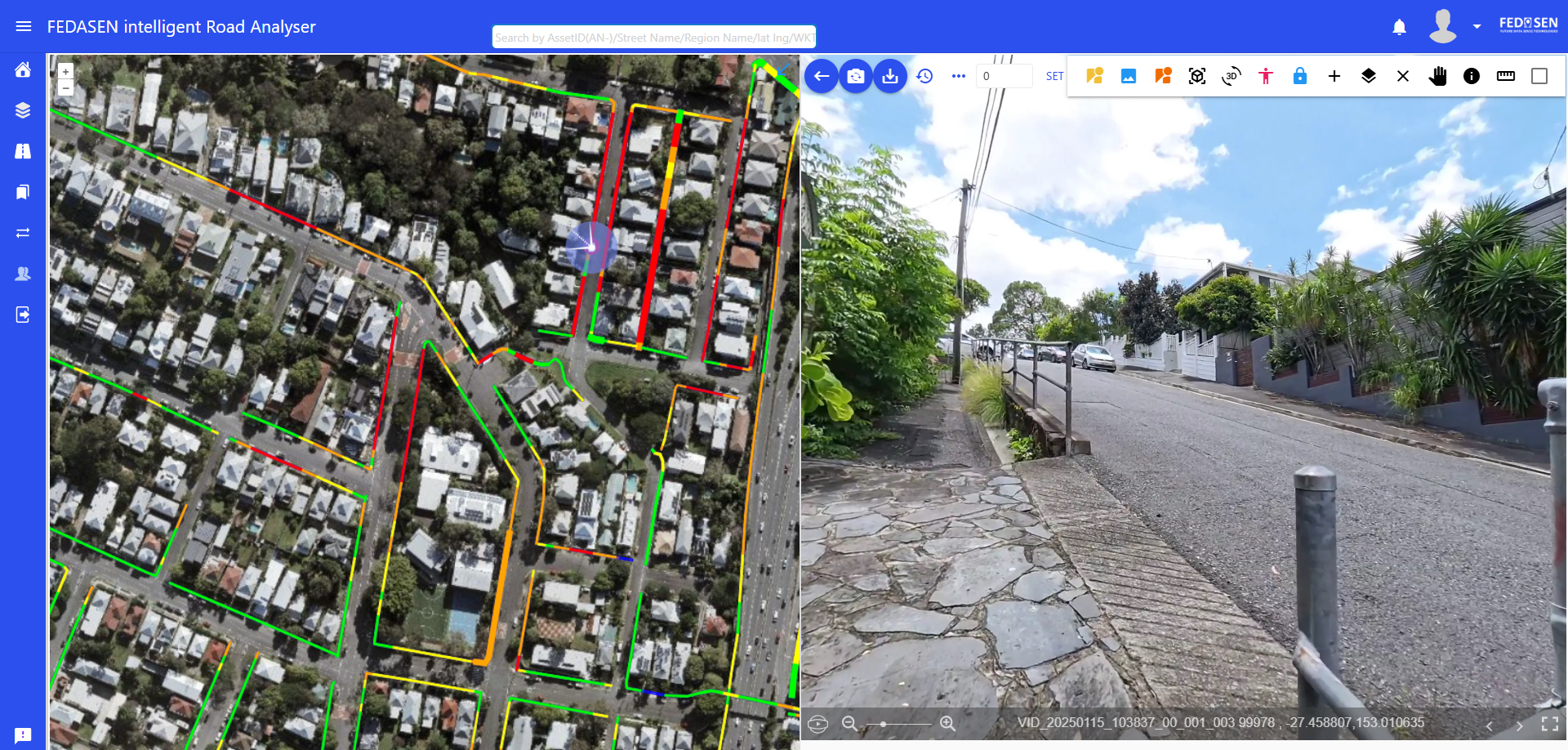
What The Service Delivers
- Effort-based route grading with colour-coded pathway segments based on gradient, crossfall, and surface condition.
- AI-powered accessibility insights detect hazards, defects, kerb interfaces, and usability factors.
- Continuous Paths of Travel mapping that highlights connectivity, barriers, and accessibility gaps
- Fully integrated 360-degree imagery provides a realistic street-level view of the pedestrian environment.
- GIS-ready datasets combined with a publicly hosted mobility map for planners, councils, and the community.
How It Works
- Capture – High-resolution 360 ° imagery and geospatial data are collected using pathway-friendly platforms designed for pedestrian environments, enabling coverage of narrow corridors and high-foot-traffic areas.
- AI processing – Fedasen FAST converts imagery into structured accessibility intelligence, automatically identifying features, hazards, and condition indicators while generating GIS-ready vectors enriched with semantic meaning.
- Accessibility analytics – Geometry, condition, and hazard data are combined at the segment level to produce effort grading, accessibility scoring, and network-level insights that support inclusive planning and prioritised upgrades.
- Public mobility map – All outputs feed into an end-to-end accessibility platform, including a publicly hosted mobility map that allows users to explore pathways visually using 360 ° imagery and accessibility-aware routing.
Why It Matters